
Flashing and Waterproofing Where Roofs Actually Leak
Field shingles rarely fail first—joints do. Step flashing, chimney saddles, pipe boots, and ice barrier transitions define whether a Greater Hartford roof stays dry through nor’easters and spring thaw.
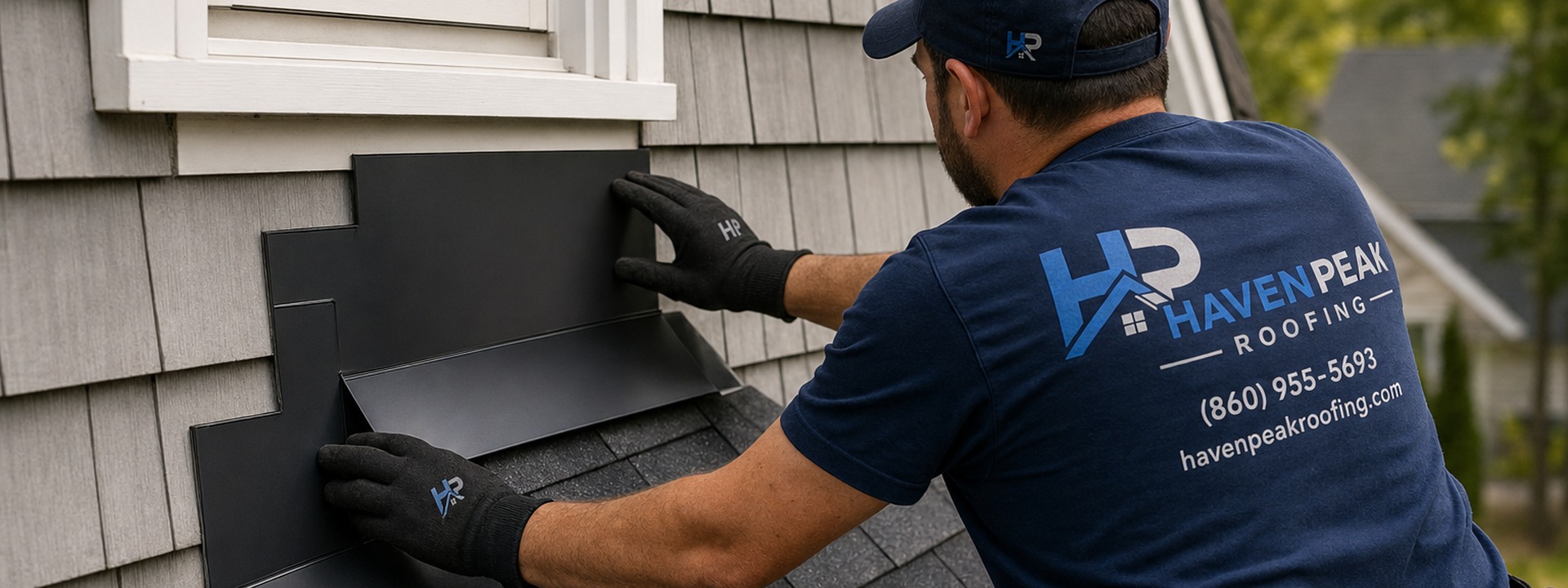
Step Flashing at Roof-to-Wall Joints
Each shingle course should integrate with L-shaped step flashing pieces up the wall. Continuous caulk beads without steps trap water on dormers and additions.
Kick-out flashing at eave ends directs water into gutters instead of behind siding—a frequent miss on older West Hartford dormers.
We rebuild steps when siding or window projects disturb existing sequences.
Fiber-cement siding clearance above step flashing must allow water to exit, not trap it.
Counter Flashing and Reglets
Counter flashing covers step flashing tops at chimneys and walls. Mortar reglets in brick chimneys must be cut or surfaced correctly; surface-applied aluminum without reglets pulls loose in freeze-thaw.
Chimney cricket or saddle flashing on wide chimneys prevents ice and debris dams behind the stack on north slopes.
Stucco and fiber-cement walls need compatible termination bars and sealant joints that move with panels.
Where Sealant Helps—and Where It Hides Problems
Quality polyurethane or sealant belongs at metal terminations and fastener heads—not as a substitute for missing flashing.
Old sealant over cracked step flashing fails within a season. We remove failed material before rebuilding joints.
Manufacturer-compatible tapes and membranes outperform generic caulk at pipe boots when integrated with the boot flange.
Expired sealant color-matched to trim still fails if the substrate moves every winter.
Signs Flashing or Waterproofing Has Failed
Catch these before ceiling damage spreads.
- Rust streaks below chimney corners or wall intersections
- Siding or stucco stains directly below step flashing lines
- Loose or bent drip edge at eaves after ice events
- Daylight visible in attic at chimney or dormer cheeks
- Granule loss concentrated in valleys with debris buildup
Chimney Flashing Rebuilds
Brick chimneys on colonials along North Main Street often outlast original flashing. Rebuilds include base flashing, step flashing on slopes, counter flashing set into mortar joints, and cricket construction when width demands.
Unused chimneys still need weatherproof caps and flashing maintenance—abandoned stacks leak at the roof plane.
Gas appliance liners may limit how flashing attaches; we coordinate clearances with your HVAC technician when needed.
Waterproofing Repair Process
Structured work prevents repeat leaks at the same joint.
- Trace interior stains to roof features upslope
- Remove enough surrounding material to expose failed layers
- Install self-adhered ice and water membrane at critical zones
- Rebuild metal and integrate with covering per manufacturer
- Water-test or wait for rain verification when practical
Ice Barrier and Ice Dam Interfaces
Self-adhered membrane at eaves and valleys provides a last line when ice backs water uphill. Width and coverage matter—code minimums may not suffice on leaky north slopes with heat loss.
Ice dams form when attic heat melts snow that refreezes at eaves. Waterproofing helps, but ventilation and insulation reduce the fuel.
We specify barrier extent during replacement and can retrofit at eaves during targeted repairs when decking is exposed.
Cable heat is a supplement, not a substitute for air sealing at attic floors.
Snow rake use from the ground can protect eaves without walking the roof.
Ventilation and Waterproofing Together
Improper exhaust through roof jacks can warp flashing boots. Mixed ridge and gable vents short-circuit intake from soffits, raising deck temperatures that stress sealants.
Balanced airflow keeps decks drier, extending flashing life. We correct vent types when waterproofing work exposes surrounding shingles.
Kitchen and bath ducts must terminate outside—not under ridge caps where moisture rots decking.
Soffit vent area should be visible from inside the attic—not blocked by insulation mats.
Painted-over soffit vents stop intake silently—maintenance visits note that.
Waterproofing on Local Roof Types
Freeze-thaw cycles open nail holes and reglet joints on homes near Reservoir No. 1. Wind-driven rain tests headwalls on hilltop properties along Albany Avenue.
Porch tie-ins behind brick facades need counter flashing coordinated with masonry—we see repeated leaks when siding contractors omit kick-outs.
Mixed metal and asphalt transitions on renovated colonials need expansion-aware details.
Flashing & Waterproofing FAQ
You May Also Need
Roof Repair
Localized roof repair for leaks, wear, and storm damage in Greater Hartford
Roof Leak Repair
Leak tracing and source repair (distinct from general repair)
Roof Maintenance
Seasonal maintenance, ice dam risk, ventilation checks
Skylight Repair & Replacement
Skylight leaks, curbs, and unit replacement
Request Flashing Help
Describe stain locations and features nearby—chimney, dormer, or wall joint.